

By Jack Rusk
In 1978, Buckminster Fuller visited Norman Foster at the newly completed Sainsbury Centre and asked: “How much does your building weigh?” Bucky was probably just flexing on Norman, but the question was well-received: Foster spent the next week calculating the answer. For an architect like Lord Foster, the question was an invitation to better understand the sum of design choices and to, using that data, find ways to make the next building a little better, a little leaner, and a lot more data-driven.
That same logic now sits at the center of the EPD ecosystem. An Environmental Product Declaration is a verified account of a product’s environmental impacts across its life cycle. For manufacturers investing in one today, there’s a pragmatic follow-up that sounds a lot like Fuller’s original: based on how much that building weighs, how much is this EPD worth?
Try as is might, a building can’t reduce its own carbon footprint. As an assembly of thousands of products from hundreds of supply chains, buildings are tangled in a complex web of supply chains and energy systems. The decarbonization of these systems allows the same for the building, and the building must in turn support the decarbonization of those systems. What needs more acknowledgement is that this can’t happen in silos, as this is necessarily collaborative work. Manufacturers redesign products to improve carbon performance, and designers specify those products. Each group’s progress depends on the other’s.
.webp)
The process of decarbonizing buildings and the products from which they’re constituted runs in parallel. In our recent webinar, Sean Darras of Lightly described what happens when a manufacturer looks at decarbonization as a design problem: “Today, we look at our decisions through a carbon lens. It’s almost like we have night vision goggles on, seeing carbon hot spots in what would otherwise be darkness.”
Sean’s team redesigned a commercial LED luminaire using bio-based materials, then used successive EPDs to drive embodied carbon down 75%. That process also made the product cheaper to produce, easier to source locally, and more appealing to customers who care about indoor environmental quality. If you squint, this is the same thought process as whole building LCA, writ small.
As excited as we are about the idea that LCA strengthens these connections, some manufacturers still approach EPDs reactively. “One of the biggest reasons that manufacturers get an EPD,” says Jack Cove at Pathways, “is that they missed the chance to bid for a project that requires one.”
“One of the biggest reasons that manufacturers get an EPD,” says Jack Cove at Pathways, “is that they just missed the chance to bid for a project that requires one.”
Designers face a parallel version of the same problem. By the time they do the LCA to recognize where the carbon hot spots lie, it can be too late to get carbon requirements into the specs. Both sides are asking the same question from different directions: the manufacturer wondering whether an EPD is necessary to get specified, the designer wondering where to set performance targets. The solution to both is early and iterative insight into carbon hot spots, so that low-carbon material selection can happen early enough to affect real outcomes.
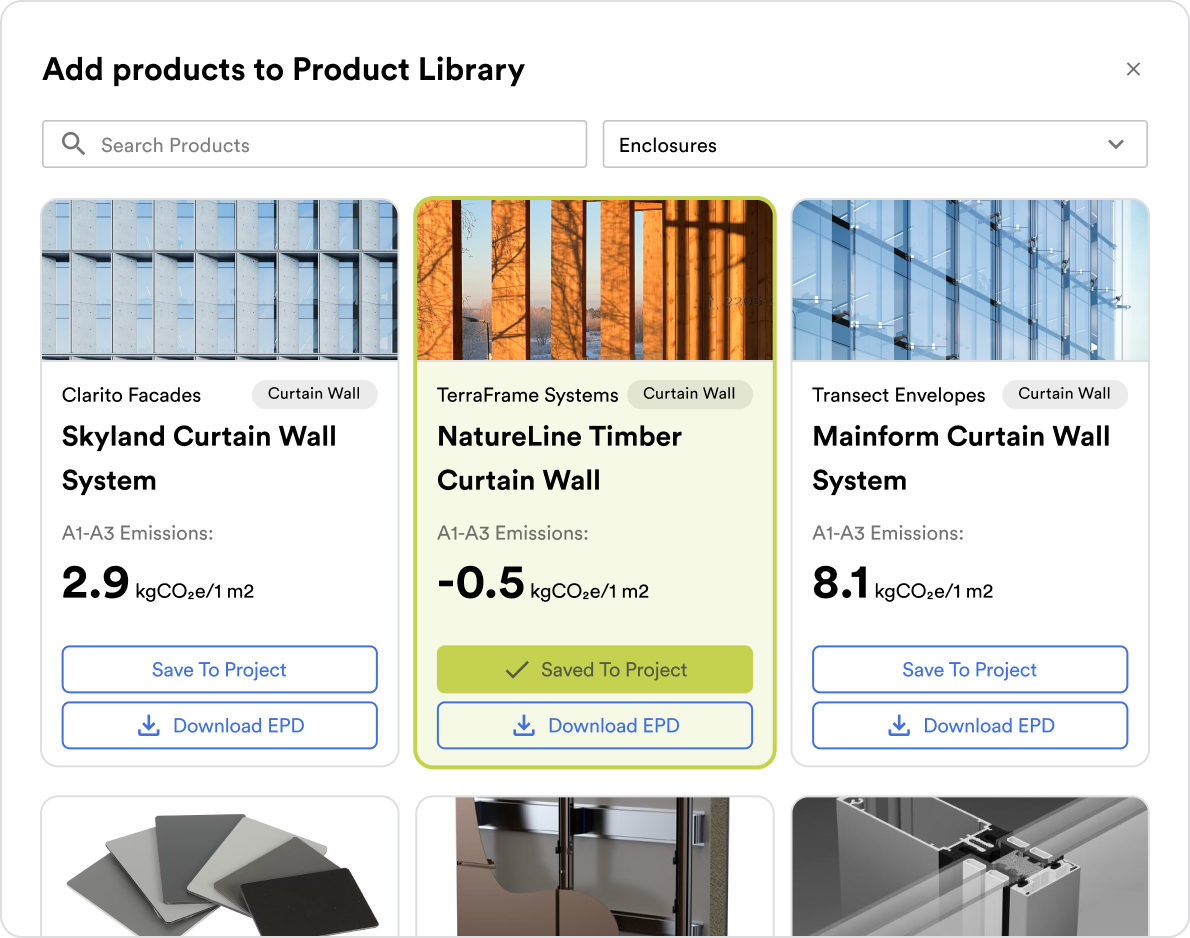
The similarities between the manufacturer’s and the designer’s journey aren’t just parallel. They’re two parts of the same process. And the meeting point between them is building-level LCA. If your product data shows up in a building’s carbon assessment, you can see the project it’s connected to. Across many assessments, you can begin to quantify the market available to products with EPDs. The demand signal sharpens from “you should probably get an EPD” into something measurable: here are the projects you can access with an EPD, and here is what they could be worth.
Video: A recent webinar hosted by C.Scale, and the inspo for this article.
The aggregated demand represented by thousands of material selection decisions is the signal we need to solve the chicken-and-egg problem between low-carbon supply chains and low-carbon buildings. This is why C.Scale is working to get a carbon assessment on every project, everywhere. Not because numbers alone are enough (admittedly, we do like them!), but because those numbers represent concerted action to build with less, and to build with better materials.
On the supply side, tools like Pathways are compressing EPD timelines from months to weeks. But as Anna Lasso of Smart EPD cautioned, “If AI is being used to aggregate data, generate the LCA models, produce the EPD outputs, and we’re asking it to do that instantly, we can’t rely on verification processes designed for static reports.” All sides of the equation need to scale together.
Project-scale LCA is the connective tissue here. The more buildings that perform carbon assessments, the clearer the demand signal for manufacturers, and the better the product options for designers. C.Scale is working to strengthen these connections in practice, because the ROI on your EPD (unlike some LCA calculations!) is simple: it’s the sum of the value of the projects where your data helps someone build a better building.


