
Insights ·
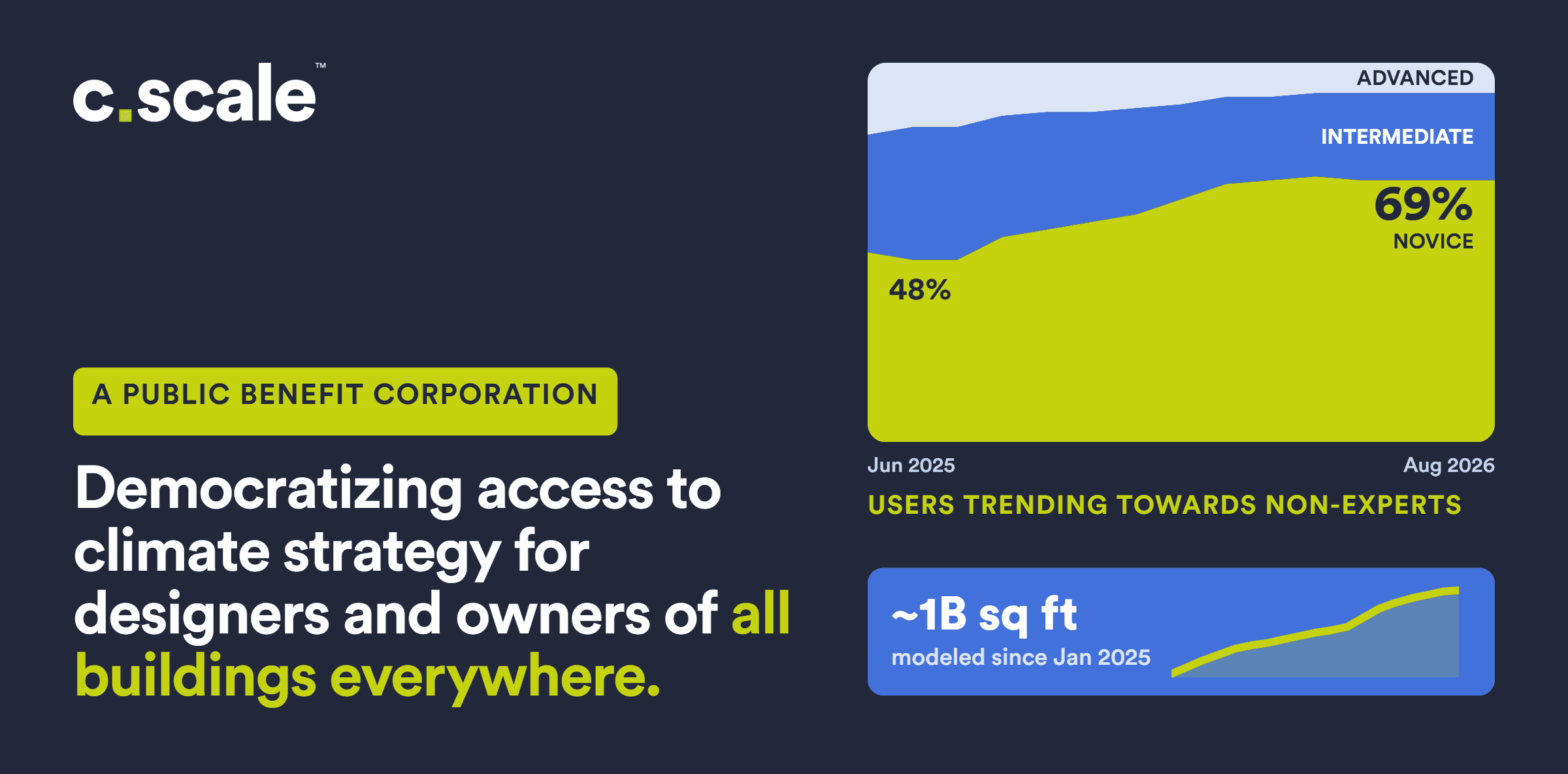
The role of ethics in software development is a hot topic these days, and rightly so. Anthropic’s IPO filing shone a light on its status as a Public Benefit Corporation (PBC), with CNBC flagging the “unusual risks” this might pose for investors. C.Scale is also incorporated as a PBC. This grew organically out of our desire to increase the speed and scale of climate action in the built environment, and seemed a well-suited option when we formed as a company.
We are proud to be an LCA software provider that centers our impact mission in our founding documents, and we believe the benefits flow through to our users. We want to explain why, how this shapes the decisions we make, and most importantly how this impacts you, our users who leverage C.Scale to advance decarbonization within their own work. Our charter obligates us to weigh our climate mission alongside financial returns, and it shows up in decisions you feel directly: how we price and package, who gets access, and how we will continue to support your companies as we evolve.
The idea that a corporation provides public benefit is both new and old. The first generation of American corporations had to earn their existence. A state legislature granted each charter by special act, and lawmakers reserved them for work they judged to serve the public: turnpikes, bridges, canals, water works. The company received limited liability and the right to collect tolls. In return it accepted a defined purpose, a fixed term, and the risk that the legislature could revoke the charter if the company strayed. General incorporation laws dissolved that bargain over the following decades, and by 1919 Dodge v. Ford Motor Co. had put shareholder returns at the center of corporate purpose. Benefit corporation statutes, beginning with Maryland in 2010 and Delaware in 2013, bring the old idea back in voluntary form.
A typical certificate of incorporation today makes maximizing shareholder value the primary duty of the board and the company's leaders. With that sole obligation in the charter, a company can over time lose the thread of the value and promise that got it started, because the share value is always the easiest thing to defend in a board meeting.
A PBC carries a second duty. Our Certificate of Incorporation states C.Scale's public benefit purpose this way:
"To support the full decarbonization of the built environment through democratizing access to climate strategy for designers and owners of all buildings everywhere."
We chose this structure deliberately. As founders of an investor-backed company with a board, we are obligated by our charter to weigh near-term financial needs against our longer-term purpose; or, viewed in reverse, this structure safeguards our ability to raise mission and purpose on an equal plane with short-term financial interests, both with investors and in board decisions.
Our big bet: climate action at the speed and scale we need starts with democratizing access to climate strategy. We all love leading firms doing exceptional projects to show the way forward, but those practices spread too slowly.
Our theory of change starts somewhere less glamorous. If every significant decision on every building project, from proposal through procurement, is informed by data on climate impact, we can start a flywheel. That flywheel shifts business as usual and produces measurable change within this decade. Four commitments follow from it:
We offer unlimited licenses. Per-seat licensing is outdated and regressive because it limits tools and data access to the experts. We want easy-to-use tools at the fingertips of every designer on every project.
We keep first cost low. Software license fees shouldn't be the friction that stops a firm from saying yes. That choice pushes our business model toward volume, and we're fine with that. Volume is the point.
We look for business value next door to carbon. We think carbon is cool, and we find life cycle assessment fascinating. Not everyone does (yet!). So we keep looking for value adjacent to carbon that makes the case obvious, both for buying the software and, more importantly, for building it into standard workflows. AIA 2030 Commitment reporting is a good example. Firms use C.Scale to make their submittals less time-intensive, and they come away with portfolio data in a platform they use every week.
We design for everyone. Most of our team are former architects, so we care about the design experience, and we know good design makes the complex feel effortless. Accessibility to a wide range of people and levels of expertise is our north star.
Our mission has taken us further than we imagined when we first built the first version of C.Scale as a research project at EHDD. C.Scale started with early-phase strategy and insights, where a design team has the most room to act. We’ve moved into BIM integration with Tally to get closer to outcomes.
Along the way we noticed a gap on the other side of the specification. The industry relies on building product manufacturers and puts growing pressure on them to publish EPDs and decarbonize their supply chains. The people inside those companies who champion that work often struggle to prove it pays off.
So we're working with select manufacturers to show there is a return on EPDs. If we can show that manufacturers who publish EPDs and work to lower the carbon content of their products win specifications at a higher rate than their competitors, two things happen. Advocates inside those companies gain evidence to justify continued investment in decarbonization. And manufacturers still on the sidelines are compelled to jump in. We wrote more about this in Weighing in on the ROI of EPDs.
If you are a building designer who wants carbon insights behind every decision, or a manufacturer that wants to see a return on your EPDs, reach out. We'd like to hear from you.